February, 2026


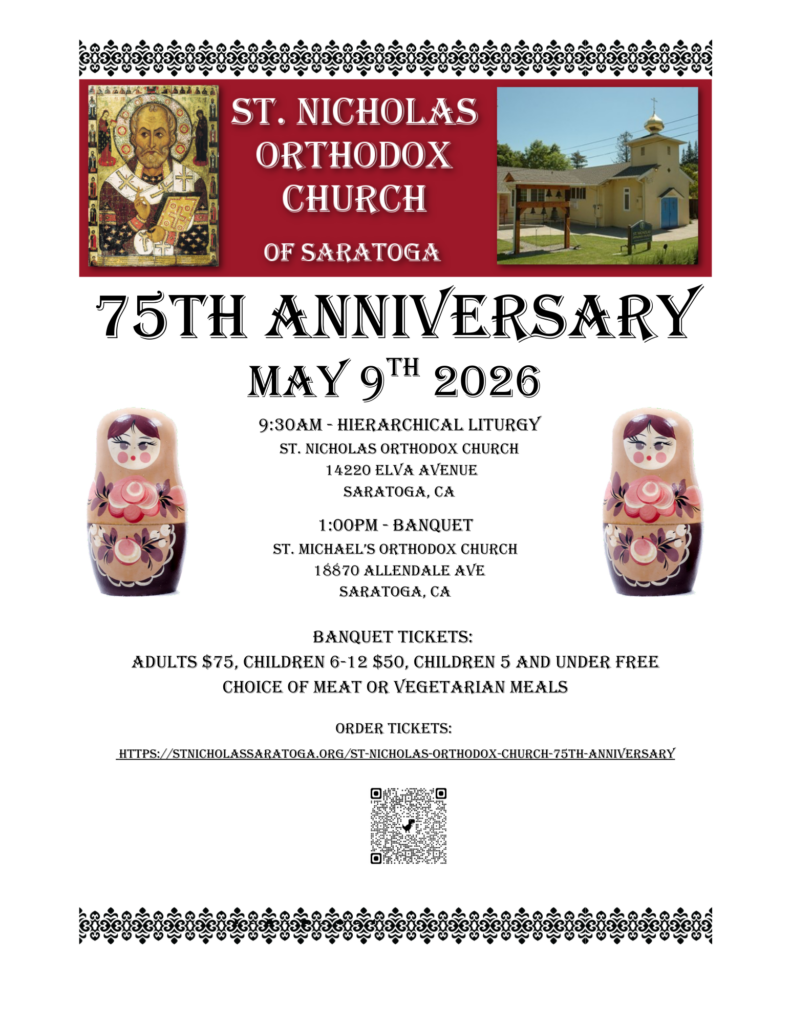
The St. Nicholas 75th Anniversary!

Focus on the Faith

Govenie: The Path of a Virtuous Life

From chapter 32 of “The Spiritual Life and How to be Attuned to it” by St. Theophan the Recluse.

(Govenie: the whole of spiritual disciplines in deepening the spiritual life and especially preparing for Holy Communion at the beginning of Lent.)

Glory be to Thee, O Lord! The fast has drawn near. You have brought me pleasure by saying that you intend to begin fasting and attending Divine Services immediately. Do not change your intention. People usually fast and attend services during Holy Week, but do not put it off until then yourself. Those who fast and attend services during Holy Week include people who have already fasted, attended services and taken Communion during the preceding weeks who desire to take Communion a second time; those who are compelled by some sort of necessity; or those for whom it is desirable to hasten the end ofthe labor of the fast, for there are only three days to labor. We will apply only the first case to you.

Lord give the blessing for you to perform govenie in a fitting manner. Each faster must do everything that you intend to do. Fast, go to church, seclude yourself, read, think and study yourself; all of this is necessary. But all of these actions must be directed toward one goal: worthy Communion of the holy Mysteries of Christ. In order to commune worthily, the soul must be cleansed with repentance. All the various actions of govenie—going to church, prayer at home, fasting, and everything else, are undertaken in order to accomplish the repentance as it should be, with sincere contrition and a firm resolution to not offend the Lord anymore.

The first thing to do in making repentance is to go inside yourself. Earthly matters and cares and unrestrained wandering of thoughts all over the place do not allow us to go inside ourselves and to study ourselves. Therefore the faster, to the extent possible during the time of the fast, shuts off his cares, and instead of going about his usual business, stays at home. This cutting off of cares is a matter of extreme importance in govenie. He who does not do so will certainly spend the fast haphazardly. You, too, must cut off your cares. No matter how few these cares are, they do exist and distract us. Set about govenie having laid aside all cares.

Let us suppose that you have cast everything aside and have gone to your room. What is there to do? It is possible to sit around in private, doing nothing. You must take up occupations that are conducive to govenie. What kind of occupations? Prayer, reading, meditation.

Prayer is that which is in addition to prayer in church. That is already self-evident. You know how to pray in church, of course. However, do take it into consideration! Go to church willingly, as to the house of God, your own home; go there without being contemptuous or bored. Go to church not just to be at the service, but in order to pray from your heart. Pray with sincere warmth, with an outpouring before God, with feelings of contrition, humility and reverential fear and with diligent petitions for your vital spiritual needs. To succeed at this, you have to think it out ahead of time, and, having come to church, you must force yourself to it. Do not just consider attendance at the service to be useless; during the course of the service the heart is warmed and calls out warmly to God. That is the main thing. You must also listen to the service, and align your thoughts and feelings with it. Variation, as long as it is directed toward one goal and is not distracting, will maintain the attention’s nourishing and constructive exertion in an agreeable manner. Attend to what is being sung and read, especially during the petitions, for they are the summary of all of the needs for which we turn to God unashamedly.

Usually, however, the thoughts do stray. This is from a lack of prayerful feeling. However, you may deal with straying thoughts in this way: As soon as you notice your thoughts have left church, turn them back and do not ever allow yourself consciously to daydream or to stray in thought during govenie,or at any other time. When the thoughts stray unbeknownst to you, this is also a small sin; but when you begin wandering offin thought purposely while you are in church, this is a sin. The Lord is among those who are in church. He who does not think about the Lord in church, but who daydreams instead, is like a man who has gone to the king in order to ask him for something, who then begins to make faces and fidget in the king’s presence, without paying any attention to him. Perhaps you will not be completely successful in preventing the straying of thoughts while maintaining your effort; but it is possible and it is necessary to not allow yourself to daydream intentionally. With respect to the straying of thoughts there are these two rules:

1) As soon as you notice this straying, turn the thoughts back, and
2) do not consciously allow the thoughts to wander.

A remedy against the straying of thoughts is mental attention, attention to the fact that the Lord is before us and we are before Him. One must place the entire mind in this though tand not deviate from it. The attention is attached to the Lordby the fear of God and by the desire to please God. From these come warmth of the heart, which draws the attention to the One Lord. Work at stirring the heart, and you will see for yourself how it keeps the thought in check. It is necessary to force yourself. Without labor and mental effort, you will notattain anything spiritual. Prostrations help a lot in the warming of the heart. Do these a little more often, performing both bowsfrom the waist and full prostrations to the ground. May the Lord grant that you feel delight in being at churchso that you will rush to it, just as people rush into a warm roomfrom the cold. During the fast, the primary stimulator of action, the reason for which we perform govenie, is worthy attendance at church. Other actions aid and assist this, but they will be discussed another time.

Some Interactive Opportunities!

The Sts. Theophan and Ignatius Study Group

We have had a study group before, but it is difficult to proceed through a book sequentially when our schedules get interrupted or are overly busy, and to keep the group in sync. Some of you expressed interest in participating but found the approach too much of a commitment.

I was involved in another Orthodox book club that solved this problem. The approach is to use an online text chat forum, where one can read and respond at one’s convenience, without everyone having to be on the same schedule. Then we can have a “live” meeting every couple of weeks for a more focused discussion, which will be helpful but optional. Occasional in-person meetings can also be had as desired.

If you would like to participate or even lurk, feel free to join the Discord. I will assign readings in the “announcement” channel, along with questions to ponder. I have also created a channel for each book or set of readings, so that comments and discussion can be focused on each reading. It is helpful to keep a journal as you read, writing down useful points from the readings and ideas for applying them to your life.

The main page for the study group is here:
https://stnicholassaratoga.org/sts-theophan-and-ignatius-study-group/

The Discord channel is where discussions take place, live meetings are held, handouts are distributed, and readings are assigned. You can sign in to that here:
https://discord.gg/TwnVnnwKcB

(Note: this Discord is separate from the St. Nicholas online members’ forum - no pledge form required).

St. Nicholas Member’s Forum

For those of you who submitted a pledge form, you are invited to participate in the St. Nicholas Members’ Forum. This includes discussion areas such as:

  • announcements
  • resources
  • general discussion
  • 75th anniversary (and other fundraiser) planning
  • parish council
  • soul-profiting quotes
  • a membership directory
  • the “beauty will save the world” discussion of soul profiting arts and letters. There is also a theater where we can show soul-profiting films and have poetry readings and such!

If you didn’t fill out a pledge form, you can still do it here:
https://stnicholassaratoga.org/pledge-form/

If you filled out a pledge form but did not receive your invite to the member forum, email Reader John or use the contact form and select “webmaster.”

Upcoming Events

Upcoming events this month are in the online calendar, which you can subscribe to on your phone or tablet. Use the print button on the calendar to print a copy.

Click below to print a copy of this newsletter:

January 2026


Orthopraxis - House Blessings and Theophany

Here is an article worth repeating!

On January 6th, Orthodox Christians attend the Divine Liturgy and the Great Blessing of the Water service to celebrate the great feast of Theophany, also called the “Feast of Lights.”  It was called the Feast of Lights from ancient times, since on this day many catechumens were “illumined” by the light of Holy Baptism and held their lit candles during the services. The feast commemorates the baptism of Christ and the revelation of God in three persons. That's why the Feast is called “Theophany,” meaning “Revelation of God.” We attend church not only to celebrate the Feast and receive the Holy Eucharist, but we also hope to be blessed by and to receive the special holy water which is blessed following the Liturgy.   Most parishioners bring their own bottles or jars from home in order to fill them up with the blessed water to take home. It is the pious practice of many Orthodox to take a little holy water and some of the blessed bread (antidoron) from church every morning before eating or drinking anything else, as a blessing for the day. In most churches in America the blessing of water is held indoors, in the temple itself, and the water is contained in a large urn. Some communities hold outdoor celebrations by a body of water.

Blessing of the Home

It is customary, to invite your priest to bless your home with holy water within the few weeks following Theophany and before the beginning of the Great Fast (Lent.). Prepare by cleaning the house and opening the doors and turning on the lights in  all the rooms.

What you need for the house blessing:

  • An icon corner or wall, or at least an Icon of Christ and the Mother of God
  • A small table, preferably covered, in front of your home icon corner.
  • A candlestick with a new candle in it, placed on the otherwise cleared table

Using  an aspergelus (a special brush-type sprinkler) the priest will go to each room and sprinkle it in the four corners blessing the home with the grace of the Holy Spirit which also protects you from evil spirits. If you were unable to attend the Theophany Liturgy, the priest will bring extra Holy Water so that you may keep some at home, near your icons. Please have a dedicated jar or vessel prepared for this water. It can only be used for Holy Water thereafter. For House Blessings, it is appropriate that all family members are in attendance, but if this is not possible, at least those who are home should participate in the service. All TV's, electronics, music, etc., should be turned off. House Blessings are a yearly tradition.

Personal Use of Holy Water

According to Orthodox doctrine, holy water has the power to sanctify and heal. Have each family member drink a small amount of the holy water from Theophany. Keep the unused holy water in your home icon corner (krasny ugol) for future use: times of adversity, before starting a new venture or trip, to give thanks, or when someone is ill. You may drink it or anoint yourself when you feel spiritually afflicted. It should be taken when fasting, if at all possible. To rid the house of evil spirits, it should be sprinkled in the four corners of each room, so no one will step on it. In the countryside, the holy water is often sprinkled in the fields and on the animals.

If you would like to have your home blessed, please contact Fr. Basil or use the Sign-up sheet at the candle desk in the Narthex of the church.

Get Ready - Sts. Theophan the Recluse and Ignatius Brianchaninov Study Group Starting!

If you are ready to grow in your spiritual life and want to share in the study of some practical instruction for doing it, then this group is for you! Why do we study the writings of these two saints? Because they tapped the deepest well in the writings of the Holy Fathers and Mothers of deep spiritual life (St. Theophan translated the Philokalia). Yet while they imbibed the depths of Orthodox tradition, they were also closer to us in time than the ancient fathers. They understood the problems that we contemporary people have, and could adapt ancient wisdom to our way of life. This is practical stuff!

We will meet on Google Meet every two weeks, on Tuesday, beginning on January 20th. You can find the link in the church's online calendar.

If you would like to know more, please read the guidelines and other information on the Sts. Theophan and Ignaty Study Group Page here:

Sts. Theophan and Ignatius Study Group

Burns Supper Fundraiser!


Get your tickets here before they are gone!

Please distribute this flyer (link) widely!

This is one of the best parties all year!

Upcoming Events

Upcoming events this month are in the online calendar, which you can subscribe to on your phone or tablet. Use the print button on the calendar to print a copy.

Click below to print a copy of this newsletter:
December, 2025


Christmas Letter

St. Nicholas Orthodox Church
14220 Elva Avenue
Saratoga, CA, 95070

December 25, 2025

Dear Parishioners and Friends of St. Nicholas,

Christ is Born!

“Behold a new and wondrous mystery! My ears resound to the Shepherd’s song, piping no soft melody, but chanting full force a heavenly hymn. The Angels sing. The Archangels blend their voices in harmony. The Cherubim hymn their joyful praise. The Seraphim exalt His glory. All join in to praise this holy feast, beholding the Godhead here on earth, and man in heaven. He who is above, now for our redemption dwells here below; and he that was lowly is, by divine mercy, raised up!” (St. John Chrysostom)

As the end of the year draws nigh, our thoughts turn to the many blessings God has bestowed upon us. Thanksgiving and Christmas both compel us to offer our grateful thanks to Him. There is perhaps no better way to show our appreciation than to lay our treasure at the feet of St. Nicholas, just as the earliest Christians laid theirs at the feet of the apostles. Please remember this holy place in your generous end-of-the-year giving. After all, the Lord says, “The year is completed, bring to Me all of your tithes and place them into my treasury; so that there shall be provision in My house: return now for this cause, saith the Lord Almighty, and see if I will not open to you the torrents of heaven, and pour out my blessing upon you!” (Malachi 3:10)

Love in Christ,

Fr Basil & Family

The Parish Council, Choir, and the entire Church Family

(Click here to make your donation online)

Open Mic Yolka!

On December 28th, the first Sunday after Christmas, we will have an informal "Yolka", with the singing of Christmas Carols, and a chance for anyone to share their talent! Bring your musical instrument or other props, and join in the joy!

Save this Date Too!

More information to come on a flyer soon!

And REALLY Save this Date!

GREAT NEWS! On May 9, 2026, we will celebrate the 75th Anniversary of Saint Nicholas Church!

Liturgy will be celebrated by Bishop Vasily and many clergy at Saint Nicholas Church. Following the service, we will drive to Saint Archangel Michael Serbian Church for a catered lunch in the hall. Please save this date, and be a part of this historic occasion. More information will be forthcoming at the Annual Meeting on January 25, 2026.

Upcoming Events

Upcoming events this month are in the online calendar, which you can subscribe to on your phone or tablet. Use the print button on the calendar to print a copy.

Click below to print a copy of this newsletter:
August, 2025


Please Help - Last Push on the Dome Project!

Focus on the Faith

Transfiguration is the Only Path to Salvation

Metropolitan Luke (Kovalenko) of Zaporozhye and Melitopol

solun.gr

Christ is in our midst. Dear readers!

If we were to pose the question to our regular parishioners today as to what we celebrate on this day, they would reply: “The Transfiguration of the Savior”. And they would be correct. The very word “transfiguration” means change. That is, something or someone used to be one way, but now they are another—they were transfigured. But did Christ change? Did He become something other than He was before Mount Tabor? No, no transformation occurred in Him. He simply partially revealed His glory, which He had, has, and will have in Himself forever. This glory is the Second Person of the Holy Trinity. If the Divine Logos showed all of His glory as it really is, then not only the apostles but the whole Earth, the entire universe would not have been able to endure this radiance. The Lord lifted the veil slightly to reveal the radiance of His Divinity so that His disciples would not be tempted when they would see Him crucified, mocked, and dead.

The Transfiguration is the vector along which our entire life should go. Every person is by nature created light, having appeared from nothing according to the divine will of the Creator. Everything in the world, both animate and inanimate, is in its essence a form of existence of the originate energy created by God. This energy has no life in and of itself. Only God is the Being that has life in and of Himself. His essence is unfathomable not only for people, but also for the highest angelic powers. And we would have no hope of eternal life had God in His mercy and love not poured out from His own essence the uncreated energies. This form of God’s being is outside of His Essence. The uncreated light of the Godhead is what the Church calls grace. By joining our human spirit with this eternally living and life-creating Divine power, we receive eternity and immortality. But so that this might come to pass, we must remove from ourselves what does not allow Divine Light to live in us. A smoky, grimy mirror cannot reflect the sun’s light. It is the same with our souls—as long as sin lives in us, our souls are unable to partake of the radiance of eternal life. Only after cleansing our souls with repentance and prayer can we not only receive God’s grace in ourselves, but we can also reflect it to other people, becoming ourselves light from Light, gods by grace from God by nature. But for this, we must have the Transfiguration.

Metropolitan Luke (Kovalenko) of Zaporozhye and Melitopol
Translation by OrthoChristian.com

8/26/2022

Orthopraxis - The Paraclesis to the Theotokos

It is customary during the Dormition Fast to chant/pray (every evening that you can) the Paraklesis service to the Mother of God. Some years we have been able to do this many times during the course of the fast, while other years seem to present obstacles, and we do it only a few times in church. But this should not be an obstacle for you!

Attached here is the service to be done at home with some instructions to do it as a "reader service" embedded. This is a great blessing to be done in the home with the family (or just yourself) gathered around the beautiful icon corner. It can be read simply, or sung as indicated.  If you want to sing and don't know the melodies, come and talk to me!

Reader John

Dormition_Paraklesis (PDF)

Upcoming Events

Upcoming events this month are in the online calendar, which you can subscribe to on your phone or tablet. Use the print button on the calendar to print a copy.

Click below to print a copy of this newsletter:

July, 2025


Orthopraxis - A Sermon by Bishop James on the feast of St. John of San Francisco

Update: Bishop James sent some edits to this sermon. It has been updated accordingly

Sermon by Bishop James on the Feast of St. John of San Francisco, 2025

In the name of the Father, and of the Son, and of the Holy Spirit.

Your Eminences, Your Graces, Reverend Fathers, dear and beloved brothers and sisters in the Lord, our Gospel today speaks of the fact that there is no greater love than can be demonstrated than when a man lays his life down for his friends. “I am the good shepherd,” says the Lord, “and the good shepherd lays his life down for the sheep.” In our midst, we celebrate one who laid his life down for his flock: Saint John of Shanghai and San Francisco.

And we are gathered like bees around a honeycomb, or like iron is drawn to a magnet. All of us in our hearts are drawn to his presence today—albeit we see him only in the remnants of his physical being from which he departed in 1966. But through our Lord Jesus Christ, neither death nor any other tribulation conquers the race of man. And St. John remains present with us this day, even as when he served in this church, or in Shanghai, or in Western Europe, or in any of the other places in which he served.

There is an extraordinary story of a priest in Siberia who was reluctant to serve Liturgy because it was 10 degrees below zero, but his Reader knocked on the door, and they had to go to church. And he prepared the Proskomedia; and as he began sensing, a few people walked into this remote village church, and he rejoiced, even though the temperature was extremely cold. Soon, the church became full of people, even those gifted in singing. He forgot how cold he was, and, momentarily, three Bishops entered the altar. They proceeded to the time of Holy Communion, where we are at this moment. And he looked at the three bishops, and he motioned to them: “Do you wish to Commune?” One of them waved him off and motioned that he should Commune. He did so. He prepared the Holy Gifts. And then he opened the curtains and the Beautiful Gates to Commune the throng of people who, to his delight, had come to church that day. But when he opened the Gates, the Beautiful Gates to the Altar, there was only one person in church, his reader, whom he Communed.

And when he returned to the Altar, there was only himself: the Bishops were not there. He began to reflect: some of these people in church looked familiar. And then it dawned on him: these were the people whom he had commemorated at the Proskomedia for the departed. And he looked on the wall of his altar, and he saw an icon of St. Basil the Great, Gregory the Theologian, and John Chrysostom. And he realized these were the three Hierarchs in his Altar. He completely forgot about the cold for his heart was full of rejoicing in the grace of God that had been visited in his church that day, showing him that in the Divine Liturgy we are united with all those who have come before us and even those who will succeed us. Today, therefore, we may be confident that St. John of Shanghai and San Francisco is a concelebrant with us today, and we are united in the Heavenly Liturgy in which he is now a participant.

When we approach St. John, do we sometimes feel: “I can't reach the heights of his labors. I can't fast so, that I eat only once a day at 11 o'clock at night. I can't sleep sitting up in a chair for an hour, maybe two hours a night. I cannot take a freezing cold water bath every morning around 3 or 4 a.m. to chase away sleep.” In a way, that is intimidating to think that we are called to such ascetic labors, which but a few in a generation are capable of undertaking.

But St. John would not ask that of us. In fact, one young man in China started sleeping in a chair and eating bread and water, I think at the age of 14, in order to imitate St. John and to be like his beloved archpastor. Needless to say, his grades started to decline and his performance in other aspects of life also began to decline, at which point his parents called this to the Saint's attention, and they met in St. John's office. St. John said to him: “So you would like to imitate me?” “Oh yes, Your Eminence, of course.” “You will do what I ask?” “Yes, I will.” It was during Lent. St. John brought this young man a thick Polish sausage and said: “Eat it.” He could not disobey his arch pastor, so he did. And Vladika admonished him firmly but with pastoral love: “Obedience is higher than ascetic labors. You are to do only what your parents ask and to come to church as you always do.” This young man later went on to be a devout priest of our Russian Orthodox Church Outside Russia.

So brothers and sisters, if St. John would not ask us to literally imitate him in his ascetic and prayerful labors, would he not also say to each one of us, as he said to this young man, for us to be obedient in the capacities to which our spiritual father calls us, to attend church as we do, to be faithful in our prayers. He would say all of those he would advise all of that to us, but most importantly he would tell us: ‘Love God.” We would not be here gathered around St. John if we were not attracted in essence to the love of God which he showed not only in his self-denial but in his service to his clergy, his fellow arch pastors, and to all the faithful that he ministered to and who asked his prayers in the years that he walked this earth. You could say that St. John's energies, his spiritual energies, were always directed up to God without interruption.

In fact, there was a homily recently given by one of our fellow hierarchs, Bishop Luke of Syracuse, in blessing a cross and a monument in a church dedicated to St. John back East. And the first words of his sermon were that St. John was 24 hours a day, seven days a week, ceaselessly devoted to God. Can any of us imagine St. John taking a break from his prayers to engage in some superfluous and frivolous distraction? It is impossible for me even to fathom that for a moment. So what St. John would advise us, not merely to say to us to love God, but he would admonish us to be very careful about allowing the energies from our soul to begin to ascend to God, but then to come back inside of us. When that happens, it is as though we have taken an electrical plug and we've unplugged ourselves from the source of all light, grace, and energy.

None of us of our own has any light to offer anyone. Jesus Christ says, “I am the light of the world.” Whatever light we possess is by virtue of whatever union we have with God, and brothers and sisters: that is up to us. The Lord does not impose union with Him upon us: we have to choose it. That’s why the Holy Apostle Paul says: ‘Pray without ceasing.” Let's put that in a different phrase: “Stay in a prayerful state so that the grace of God can continually inform you through your heart, your conscience, and your intuition.”

How many of us would say: ‘Well, my own judgment is better than the informing of God.” And yet, that is exactly what the fall of man is. It's the fall of the angels that fell away from God, too. They thought they could do it better than God. A false sense of autonomy! And we've all heard it, too: the “self-made man. I don't need God. I don't need my parents. I don't need my priest. I'm making this decision myself.” This is a strong pull within the nature of each one of us—to be a kind of independent contractor as though we are omniscient, omnipresent, and have all the characteristics of God, and He's an afterthought. “I'm making this decision myself.”

The minute we unplug from the grace of God, what happens to us? We become isolated. And an isolated soul is then vulnerable to the influence of the adversary of man. You all know the story about St. John at a Bishops’ conference, and when the discussions were done, one bishop wanted to say to him, “Pomolimsya Vladika. (Let us go pray, Your Eminence.)” He opened his mouth, but he couldn't say those words. Why? He could see St. John was already in a state of prayer. Why would you say to somebody, “let's go pray” when their prayerful state convicts you of the fact that you're not prayerful yourself. During this beautiful Divine Liturgy, brothers and sisters, could any of us start worrying about the concerns and cares that we have? We were vouchsafed to lay aside all earthly cares to be in the presence of God and his Saints, and in particular, St. John. There is another church where we can find the same feeling as we have here today in this grace-filled service. If only we choose to fill that church with the same grace that we find here today. Where is that church? That church is entitled, The Church Beneath the Roof of the Temple of My Soul.

What we see here today, the singing, the reading, the candles, the incense, the prayer, the candles, the incense, the prayer. That is what we must have within our own church beneath the roof of the temple of our soul. And that is why being in a prayerful state unceasingly is such a blessing. It means that our speech, our thoughts, and our actions will be informed by the Divine Grace rather than by us trying to put the burden of figuring everything out in our lives on our own shoulders with our own faculties and resources.

St. John, therefore, stayed plugged in to the grace of God. The adversary of mankind's constant effort is to get us to unplug so that he can have a conversation with us and fill our being with every manner of stress and propaganda. And he will tell us that prayer is an oppression: “Oh, you can pray later tonight. Just be with your own thoughts, your own fantasies, your own daydreams.” But we don't have to do that in our lives, brothers and sisters, and the consultant or the mentor in the art of staying in prayer with and connected to God, so that every moment is informed and protected, empowered, and filled with the Divine Grace is (pointing to St. John) there in our midst. And all we have to do is to call upon him, and he will be instantly in our midst to help us. A phrase in our Holy Orthodox faith says: “Wondrous is God in his Saints.” To Him be glory, honor, and dominion forever. Amen!

Upcoming Events

Upcoming events this month are in the online calendar, which you can subscribe to on your phone or tablet. Use the print button on the calendar to print a copy.

Click below to print a copy of this newsletter:

The Vital Importance of Celebrating the Parish Feast Day.

All Orthodox temples are dedicated to someone. When Christians were first able to build churches, they built them on holy sites associated with events in scripture, the life of Christ, or over the tombs of the martyrs. And if there was no holy site at hand, nonetheless, a church would be dedicated in the name of a person or an event marked on the church calendar. We continue this tradition. In short, our churches always have their own special feast day called the patronal feast or, more accurately, the altar feast (Престольный праздник).

Our parish is dedicated to St Nicholas the Wonderworker, one of the most beloved saints of the Orthodox World. While his main celebration is held on December tith, our temple was consecrated on May 9/ 22, 195ti, the date of the transfer of his relics from Myra in Asia Minor to Bari, Italy. So, our altar feast is held on what the Russian people affectionately call “Spring Nicholas.”

The celebration of the parish feast day ought to be considered what the Latins used to call a “Holy Day of Obligation.” What does that mean? It means that all parishioners should make every possible effort to be in church on that day. Why? Because just as we expect St Nicholas to watch over us, and hear our prayers, we need to attend to him and honor him on his special day. Also, the saints, on their feast days, come as close to us as is possible to hear our prayers and intercede for us!

Please…come!

Love in Christ,

Fr. Basil

  • Patronal Feast Vigil: Thursday May 8th at 6:00PM
  • Patronal Feast Liturgy and Feast: Friday May 9th at 10:00AM
Review Your Cart
0
Add Coupon Code
Subtotal